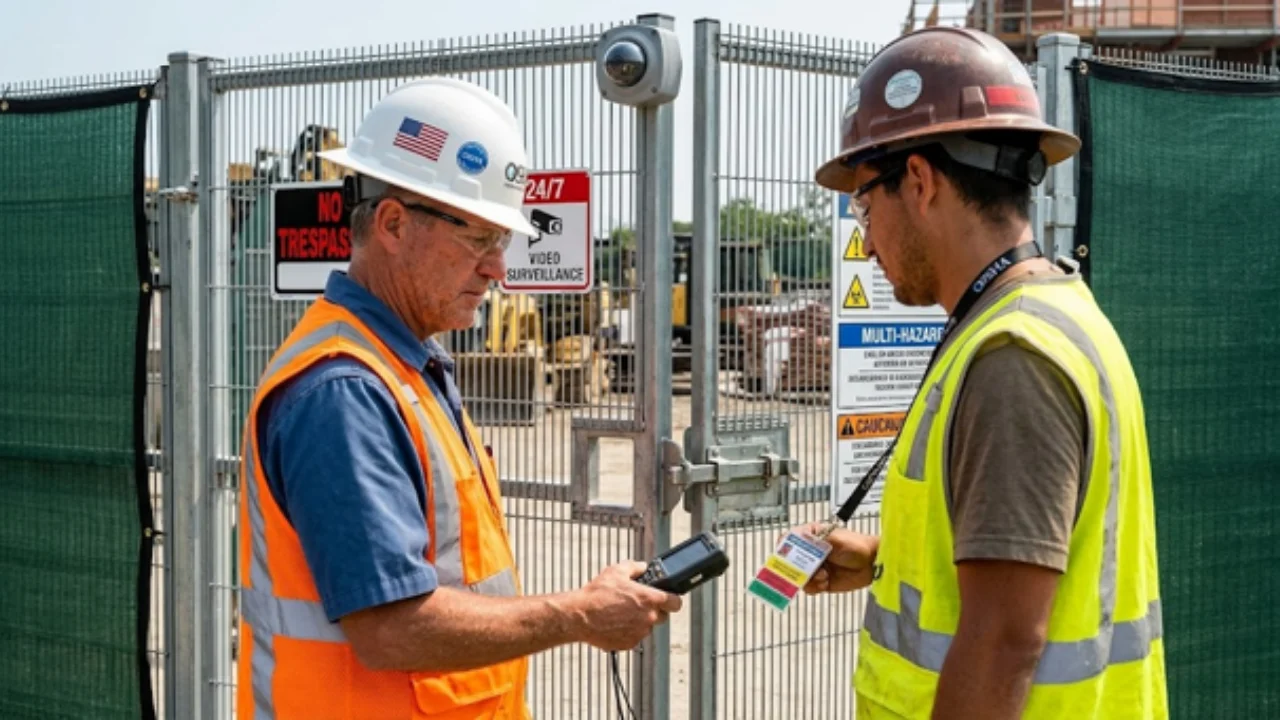
If you run construction projects in the United States, the 2025 numbers should get your attention.
TrueLook’s 2026 State of Construction Site Security report documented 2,639 confirmed break-ins across active U.S. commercial construction sites in 2025, a 50% increase over fewer than 1,750 break-ins the year before. The U.S. construction industry loses an estimated $1 billion annually in equipment theft alone. The U.S. Department of Energy estimates an additional $1 billion in copper is stolen from construction sites each year. And copper prices near $8 per pound in early 2026 have made that threat more organized and more aggressive than ever.
National Equipment Register (NER) data identifies the Friday before Labor Day as the riskiest day of the year for job-site theft, when crew oversight drops and long-weekend coverage gaps open across sites from coast to coast.
These are not random incidents. They are predictable, seasonal risks with a documented cost structure. Our guide on construction site theft prevention covers the foundational strategies. The 12 controls below build on that with a layered security framework tailored to American job sites.
Why American Job Sites Are Most Vulnerable in Summer
Summer accelerates risk on U.S. job sites in three converging ways: peak labor volume, extended exposure windows, and seasonal crime escalation.
Multiple subcontractor trades overlap simultaneously on ambitious summer schedules. Framers, mechanical, electrical, plumbing, and HVAC crews all work in parallel. Crew rosters shift daily. New subcontractor workers arrive before the induction paperwork is complete. The number of people moving through a single gate increases significantly compared to the spring or fall phases.
Research indicates that approximately 50% of estimated U.S. construction site thefts involve internal personnel, including employees and subcontractors. Summer’s fluid roster dynamic widens that window. And property crime overall increases by up to 35% in the summer months, a trend that disproportionately affects construction sites given their open perimeters and high-value material inventories.
August registers the highest construction site theft rate nationally, but June and July are the onset months, when the conditions that create August’s peak are already in place.
Steel welded wire mesh Fence Panels vs. Chain Link for U.S. Job Sites
The most important security decision on any American job site is the physical perimeter barrier. Chain link’s woven diamond pattern can be cut with standard bolt cutters in under 60 seconds. Steel welded wire mesh welded wire panels fuse steel wires at every intersection, requiring specialized tools and significantly more time to breach. Welded mesh offers approximately 50% greater tensile strength, reaching up to 60,000 PSI, compared to 30,000 to 40,000 PSI for standard chain link. For sites where maximum anti-climb and anti-cut performance is required, the Anti-climb Platinum Fence Panel delivers the highest security rating in the Broadfence product line. It is OSHA-compliant for American construction site perimeters.
OSHA identifies a secured perimeter as the first line of defense against third-party intrusion. Steel welded wire mesh panels are what make that first line effective. They also produce cleaner surveillance camera footage than chain-link’s overlapping diamond grid, a practical advantage when reviewing footage after an incident.
12 U.S. Construction Site Security Controls for Project Managers and Superintendents
1. Perimeter Foundation Controls
Single Controlled Entry Point
Channel all personnel through one defined, monitored gate. Each additional entry point multiplies breach risk. Steel welded wire mesh panels allow precise perimeter configuration with gate placement optimized for supervision. For U.S. sites with multiple contractor access needs, designate one primary gate and one secondary gate only, and staff both.
Panel Height for U.S. Commercial Sites
Standard options are 6-foot and 8-foot panels. For U.S. commercial sites near public rights-of-way or storing copper, HVAC, or generators, 8-foot panels are the stronger deterrent. Check local municipal codes and state OSHA requirements before specifying height; standards vary by state and project classification.
Daily Perimeter Inspection at Shift Start
Walk the fence line every morning before crews begin work. In U.S. summer heat, expansion and contraction can stress panel connections. Wind from afternoon thunderstorms common across the Midwest and Southeast can displace panels overnight. A breach discovered at 6:00 AM is a preventable theft; discovered at noon, it is already a loss.
2. Gate Access Technology Controls
Digital Credential Systems for Rotating Subcontractor Crews
RFID badges, QR codes, or biometric verification linked to induction status are the core solution for summer subcontractor churn on U.S. job sites. New workers receive credentials only after completing site-specific safety induction, and credentials deactivate immediately when a crew rolls off the project.
Biometric Verification for High-Value Zones
Facial recognition or fingerprint scanning eliminates card-sharing and buddy-clocking, which are documented risks when dozens of unfamiliar subcontractors rotate through a U.S. commercial site each week. Integrated platforms like Hammer Tech and Irongate provide compliance tracking, biometric access, and labor audit trails within a single system that is compatible with U.S. OSHA recordkeeping requirements.
Color-Coded, Trade-Specific Access Credentials
Color-coded ID badges allow site superintendents and gate personnel to identify trades and clearance levels instantly. A low-cost layer that pays off every day on large American commercial sites where multiple trades overlap simultaneously.
Documented Visitor Log and Escort Policy
Every non-employee, including OSHA inspectors, municipal building officials, delivery drivers, and equipment rental reps, must sign in and out with ID verification and an escort. In summer, these visits spike, and each is a potential vector for unauthorized access without documented control.

3. Surveillance and Lighting Controls
Gate Cameras with Remote Monitoring
Position cameras at all entry points for real-time monitoring and recorded footage. Remote-monitored camera systems are especially effective over the Labor Day long weekend; NER data identifies this as the highest-theft period of the year nationally. Most U.S. construction site break-ins occur when the site is unattended; remote surveillance closes that gap.
Motion-Activated Lighting at Gates and Laydown Areas
Illuminate entry points and high-value material storage areas without creating shadows that block camera angles. Motion-activated lighting is a particularly effective deterrent for the after-hours and early-morning theft windows that account for the majority of U.S. construction site incidents.
4. Administrative Controls
Daily Roster Reconciliation by 7:00 AM
Require each subcontractor supervisor to submit a confirmed crew list by 7:00 AM every workday. Gate personnel reconcile arrivals before granting entry. This daily audit loop catches unauthorized additions, a documented insider threat vector on U.S. commercial sites.
Materials and Equipment Inventory Log
Document every item from order through delivery and installation. Only 21% of stolen U.S. construction equipment is ever recovered. A current inventory log is the difference between a covered and an uncovered insurance loss, and it reduces investigation time dramatically when a theft occurs.
Prominent Deterrence Signage at All Access Points
Post ‘No Trespassing’ and ’24/7 Video Surveillance’ signs at all entry points. Visible camera placement and security company branding at the perimeter are documented deterrents. A site that demonstrates active monitoring is a less attractive target, particularly for organized theft crews targeting U.S. commercial sites with valuable copper and HVAC inventories
Temporary Fence Privacy Screens: A U.S. Contractor's First Defense Against Copper Theft
Copper at $8 per pound. HVAC units on the ground for pre-installation. Generators on open lots. On any U.S. commercial construction site in summer, the materials most targeted by theft crews are also the most visible from the street, which is precisely where the threat originates.
A temporary fence privacy screen eliminates that visual trigger. By blocking sightlines from street level into the site, privacy screens remove the cue that initiates both opportunistic and planned theft. They also signal active site management, a documented deterrent effect in urban U.S. construction markets where open sites are surrounded by pedestrian traffic and public sightlines.
For a deeper look at how privacy screens work in practice on American job sites, see our post on preventing site theft with fencing privacy screens . Steel welded wire mesh temporary fence panels are the ideal attachment platform: the welded-grid face provides a uniform, rigid surface that holds screen material against wind and weather without sagging, a failure mode common with chain-link frames.
A single prevented copper or HVAC theft at the NIBRS average of $5,865 pays for 1,000 to 3,500 linear feet of commercial-grade screen. For U.S. sites storing copper at record prices, that math is straightforward.
The True Cost of One Theft Incident on a U.S. Job Site
American project owners typically evaluate security investment against direct replacement cost. That number is real, but it is the smallest component of what a single theft incident actually costs.
The full cost chain following a U.S. construction site theft:
- Work stops at shift start for police reporting, inventory reconciliation, and investigation access.
- Subcontractors whose work depends on stolen materials cannot proceed and must be rescheduled, in the peak U.S. summer season, which means weeks of delay.
- Replacement materials must be reordered. For HVAC equipment, copper, or specification-grade items, U.S. supplier lead times compound the delay.
- Downstream trade cascade: crane operators, material suppliers, MEP inspectors, and finishing trades all shift based on the new timeline.
- Rushed catch-up work under schedule pressure increases error rates and OSHA recordable incident risk.
Add it all up, replacement value, idle labor, subcontractor rescheduling premiums, insurance deductible and premium increases, and downstream cascades, and the true all-in cost of one theft incident lands between $13,000 and $87,000 or more. Only 21% of stolen U.S. construction equipment is ever recovered. Filing a claim also increases your premium across future projects.
Against that exposure, a fully specified Broadfence iron-mesh perimeter is a measurable, one-time investment. Explore our construction and demolition fencing solutions to see what the right configuration looks like for your U.S. job site.
Secure Your U.S. Job Site Before the Summer Theft Peak
American construction site theft is not declining; it is accelerating. With confirmed break-ins up 50% year-over-year and the true cost of a single incident reaching five or six figures, perimeter security is a scheduled decision, not just a safety one.
The 12 controls in this guide, from steel welded wire mesh panel foundations through RFID access, privacy screening, remote surveillance, and administrative reconciliation, reflect what industry data consistently identifies as the most effective layered framework for U.S. commercial construction sites.
Summer is peak season. Put these controls in place now, before your roster swells, before your laydown fills with copper and HVAC equipment, and before the Labor Day window opens.
Ready to spec the right perimeter for your U.S. job site? Contact Broadfence at 1.855.993.0499 or visit broadfence.com. Safe. Simple. Secure.