What You Need to Pass Inspection This Spring
Spring is the season that exposes every shortcut taken in the fall. Frozen ground thaws unevenly, soil loses bearing strength faster than most sites plan for, wind exposure increases as crews clear vegetation and close out winter work, and the volume of people, equipment, and deliveries accelerates sharply. Every one of those factors acts directly on your fence base system. The specification that held in October may not hold in April.
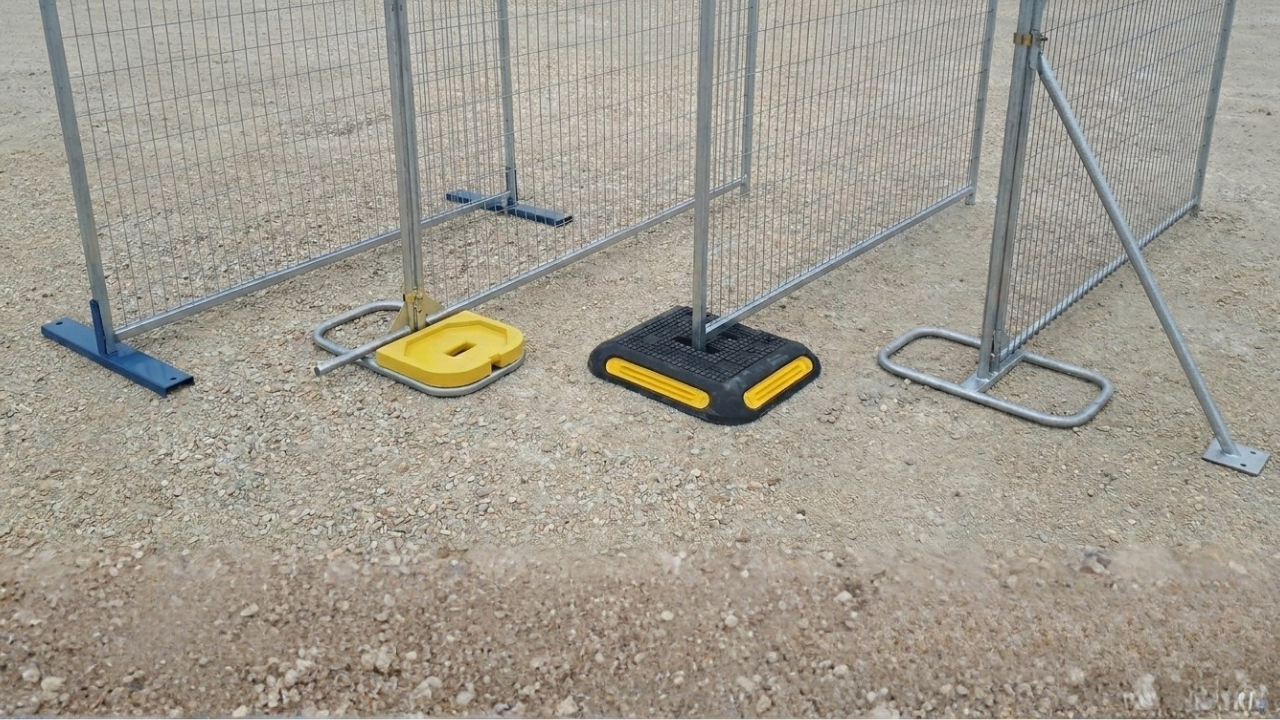
This guide covers the four primary base types used on North American construction sites: Broadfence Broadfoot, Anticlimb Tube Stand, Zero-Trip Stabilizer Base, and Elite Feet. It also covers how to select the right base for your surface and wind conditions, T-bar anchoring depth and spacing for spring ground, and the gate planning decisions that determine whether your perimeter runs smoothly or becomes a daily operational problem.
Why Base Selection Matters More in Spring Than Any Other Season
Most temporary fence failures do not start with the panel. They start with a base system that was specified for conditions it is no longer sitting in. Frost heave shifts the base laterally. Snowmelt saturates the soil beneath steel feet. Freeze-thaw cycling works loose every coupler fitting and post connection along the fence line.
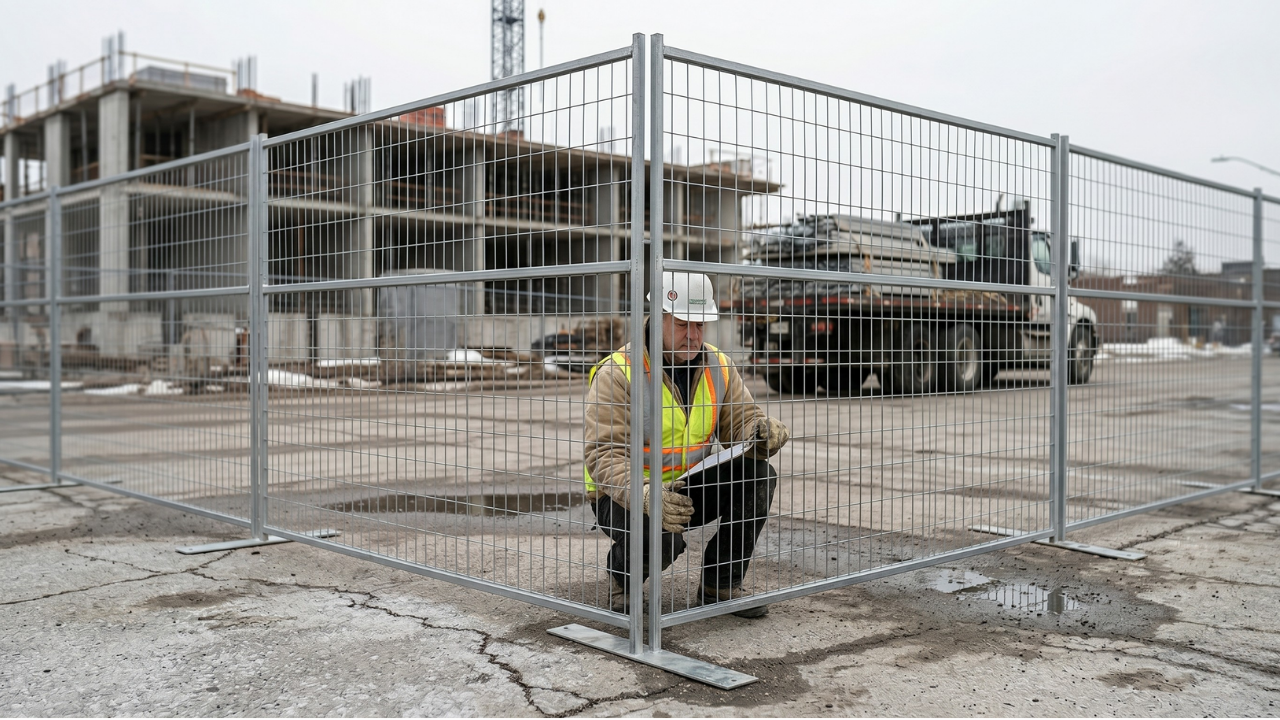
At the same time, spring mobilization compresses the inspection window. Municipalities and provincial authorities increase site inspections at the start of construction season, when winter-degraded perimeter systems are most exposed. A fence that passed in November may fail a spring push-test under 29 CFR 1926.502 guardrail criteria or local ordinance height and stability requirements. That failure does not produce a correction notice. It produces a stop-work order.
Confirming your base selection before mobilization rather than after the first inspection is one of the highest-return decisions in the pre-season planning window. The Broadfence product line gives you purpose-built options for every surface type, load condition, and compliance requirement on the job.
The Broadfence Base System Lineup
Broadfence supplies four primary base products engineered for North American construction sites. Each is designed for a specific surface type, wind condition, and operational context. None of them is universally superior. The right choice depends on what your site is actually asking the base to do.
Broadfoot and Anticlimb Classic and Platinum Panel Tube Stand
The Anticlimb Classic and Platinum Panel Tube Stand is the heavy-duty primary base for commercial and infrastructure projects across North America. It is a welded steel cradle that slots directly onto the bottom rail of anticlimb panels, distributes load over a wide footprint, and performs reliably on asphalt, compacted gravel, and hard urban surfaces. For commercial projects where panel height, strength, and inspection compliance are the primary priorities, this is the correct specification.
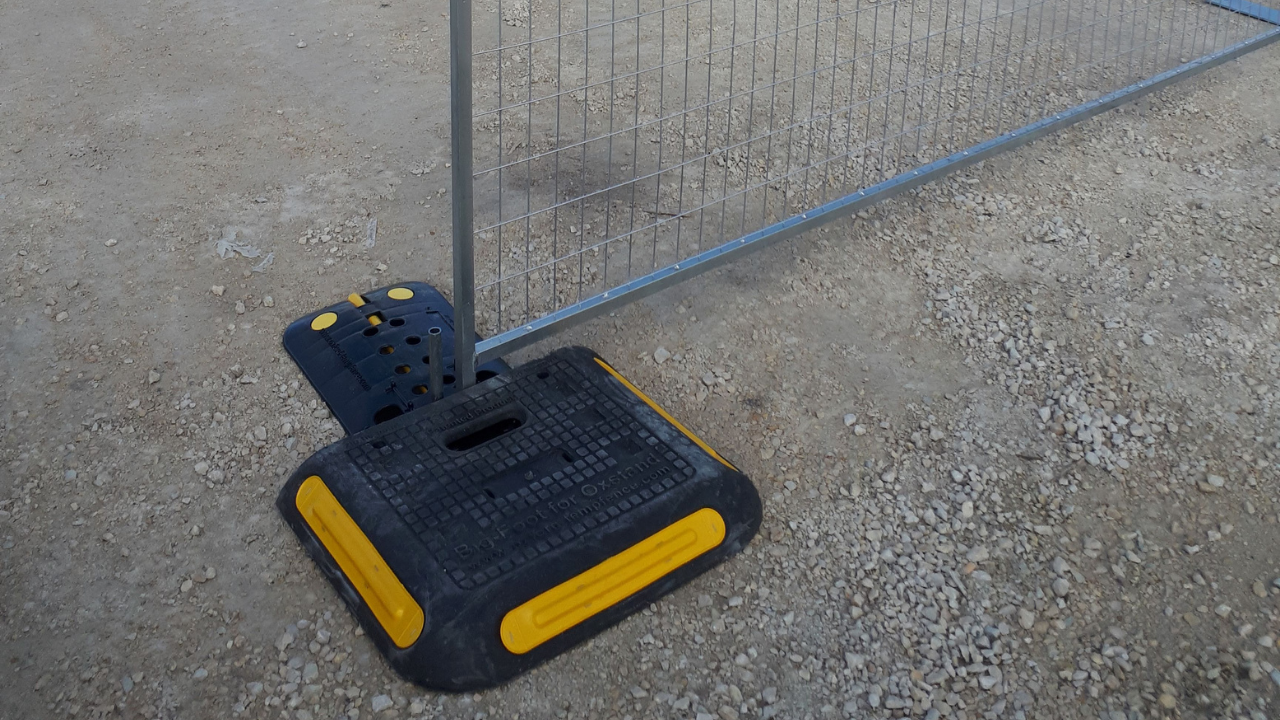
The Broadfoot fence weight pairs directly with the tube stand to handle ballast requirements on screened runs and spring-exposed positions. Unlike heavy concrete blocks, the Broadfoot is 100% recyclable, fits easily over standard temporary fence stands, and includes a low-profile high-visibility yellow accent that reduces pedestrian trip hazard. It is compatible with Anticlimb Classic and Platinum Panels, and it installs in seconds with no mess and no strain on your crew.
For most urban commercial projects in North America where ground penetration is not viable, the Anticlimb Tube Stand with Broadfoot ballast is the correct spring specification. On any screened or wind-exposed run, the Broadfoot replaces the need for sandbags while delivering better weight distribution and easier handling.

Broadblock and Select Stand (Canada)
The Broadblock and Select Stand are lower-profile base options designed for select-range panels on sites where portability and ease of repositioning are priorities. Both perform well on finished and semi-finished surfaces. For Canadian construction sites, the Select Stand is the standard portable base specification for select-range applications.
In spring conditions, any outdoor run using the Broadblock or Select Stand should be supplemented with Broadfoot fence weights to maintain lateral resistance as ground conditions shift. The combination of a lightweight primary base and targeted Broadfoot ballast gives site crews the flexibility of a portable system without compromising stability on exposed runs.
Zero-Trip Stabilizer Base and Anticlimb Premium Panel Thermoplastic Hi-Viz Foot
The Zero-Trip Stabilizer Base and the Anticlimb Premium Panel Thermoplastic Hi-Viz Foot are Broadfence’s purpose-built solutions for pedestrian-adjacent fence runs. Both are engineered for sites where the fence line sits close to public foot traffic. The thermoplastic or rubber compound absorbs impact, reduces trip hazard to near zero, and delivers a high-visibility color profile that satisfies safety requirements at pedestrian access zones and sidewalk-adjacent runs.
On dry, level surfaces with moderate wind exposure, both bases perform reliably as standalone systems for standard-height panels without screening. Their primary application on spring construction sites is at pedestrian gates, sidewalk interfaces, and any location where the trip hazard profile of a steel flat foot or tube stand raises code concerns or creates liability exposure.
On runs exposed to strong spring winds or carrying privacy screening or branding fabric, supplement both bases with Broadfoot ballast. The lower mass of thermoplastic bases is a trade-off worth managing with targeted ballast rather than switching to a heavier base that creates a trip hazard at a pedestrian interface.
Elite Feet and Windbreak Stabilizers
The Elite Feet base is designed for applications that require a clean, professional appearance with reliable surface contact on finished floors and paved surfaces. Like other surface-mounted bases, Elite Feet require Broadfoot ballast on any screened or spring-exposed run to maintain adequate lateral resistance.
Windbreak stabilizers are structural bracing components, typically triangular or A-frame steel brackets that attach to fence panels and extend outward to increase the effective base width and resist overturning. They are not a standalone base type. They work in combination with any Broadfence primary base to handle wind loads that exceed what a ballasted base-and-panel system can manage alone.
The rule is straightforward: any fence run carrying privacy screening, branding fabric, windscreen, or any other solid or semi-solid material requires windbreak stabilizers in addition to the primary base. The moment you attach screening to a panel, you convert it from an open lattice that lets wind pass through to a surface that captures it. Overturning load increases substantially, and ballast alone is not sufficient.
On spring sites, windbreak stabilizers are also the correct specification for any run on an elevated or exposed position: rooftop edges, elevated decks, sites adjacent to open water, and corner runs that catch wind from multiple directions.
How to Choose the Right Broadfence Base for Your Site Conditions
Once you have confirmed three site variables, surface type, wind exposure, and whether the fence run will carry attached material such as screening, the selection is straightforward.
- Asphalt or compacted gravel, moderate wind, no screening: Anticlimb Tube Stand. Standard specification for commercial and infrastructure sites. Add Broadfoot fence weights for any screened or spring-exposed run.
- Finished or smooth indoor surface, no screening: Broadblock or Select Stand with Broadfoot ballast. Protects the surface and distributes load over a manageable footprint.
- Pedestrian-adjacent run or sidewalk interface: Zero-Trip Stabilizer Base or Anticlimb Premium Panel Thermoplastic Hi-Viz Foot. Minimizes trip hazard and satisfies pedestrian safety requirements at public interfaces.
- Any run with screening, branding fabric, or windscreen: Primary Broadfence base per above, plus windbreak stabilizers. No exceptions in spring wind conditions.
- Soft, thawing, or saturated soil: Anticlimb Tube Stand with Broadfoot fence weights plus windbreak stabilizers on all exposed runs. Re-check base level after each thaw cycle.
- Urban sites where ground penetration is prohibited: Weighted surface systems only using Broadfoot ballast. Confirm local utility locate requirements before finalizing any penetration decision.
Spring conditions push most surface-mounted base systems toward a combined approach: a primary Broadfence base matched to the surface, Broadfoot ballast for weight and stability, and windbreak stabilizers on any run exposed to wind load or screening. Specifying a single base type without accounting for spring soil conditions and screen loading is the most common base selection error on North American construction sites.
T-bar Anchoring in Spring Ground: Depth, Spacing, and What Can Go Wrong
T-bar anchoring, driving a steel T-post or rebar stake through the base foot and into the ground, is the most effective way to lock a surface-mounted base system against lateral movement when ground penetration is permitted. It converts a gravity-dependent system into a mechanically anchored one, which is a meaningful stability upgrade under spring wind and soil conditions.
Depth and Spacing
For spring conditions on North American construction sites, the following anchoring parameters apply as a working guideline:
- Anchor depth: 18 to 36 inches, depending on soil conditions. In soft, thawing, or saturated ground, drive to the deeper end of the range. In firm, compacted subgrade, 18 inches provides adequate resistance. Never terminate an anchor in frost-affected or saturated soil at a shallow depth. The anchor will pull out under lateral load.
- Anchor spacing: Every 6 to 10 feet along the fence run, depending on wind exposure and panel screening load. On screened runs or exposed corners, anchor every 6 feet. On protected interior runs without screening, 10-foot spacing is adequate.
- Utility locates: Non-negotiable. In the U.S., call 811 before any ground penetration. In Canada, contact your provincial utility locate authority. Compressed spring mobilization timelines do not override locate requirements.
Spring-Specific Anchoring Risks
- Frost heave: Repeated freeze-thaw cycles push anchors upward through ice lens formation. An anchor set at 24 inches in March may be at 12 inches by late April. Re-check anchor depth after each thaw event and re-drive as needed.
- Soil instability: Thawing soil loses bearing strength temporarily as ice melts and drainage catches up. Set anchors after the thaw front has stabilized, not during active thaw. An anchor set in actively thawing soil may not achieve the resistance you measured at installation.
- Re-checking requirements: Any T-bar anchor installed before winter or during early spring thaw should be physically re-checked before the fence is placed in service for the full construction season. Pull by hand, probe, or re-drive as needed. This step is consistently missed on sites where winter-installed anchors are assumed to be still holding.
Gate Planning for High-Traffic Spring Sites
Gate placement and specification are where perimeter planning most directly affects site operations. A gate that is correctly sized, positioned, and equipped with inspected hardware disappears into the background of daily site activity. An undersized, incorrectly positioned, or corroded gate becomes a friction point that costs field time every day. Spring startup is the right moment to make these decisions intentionally rather than reactively.
Vehicle Gate Sizing and Placement
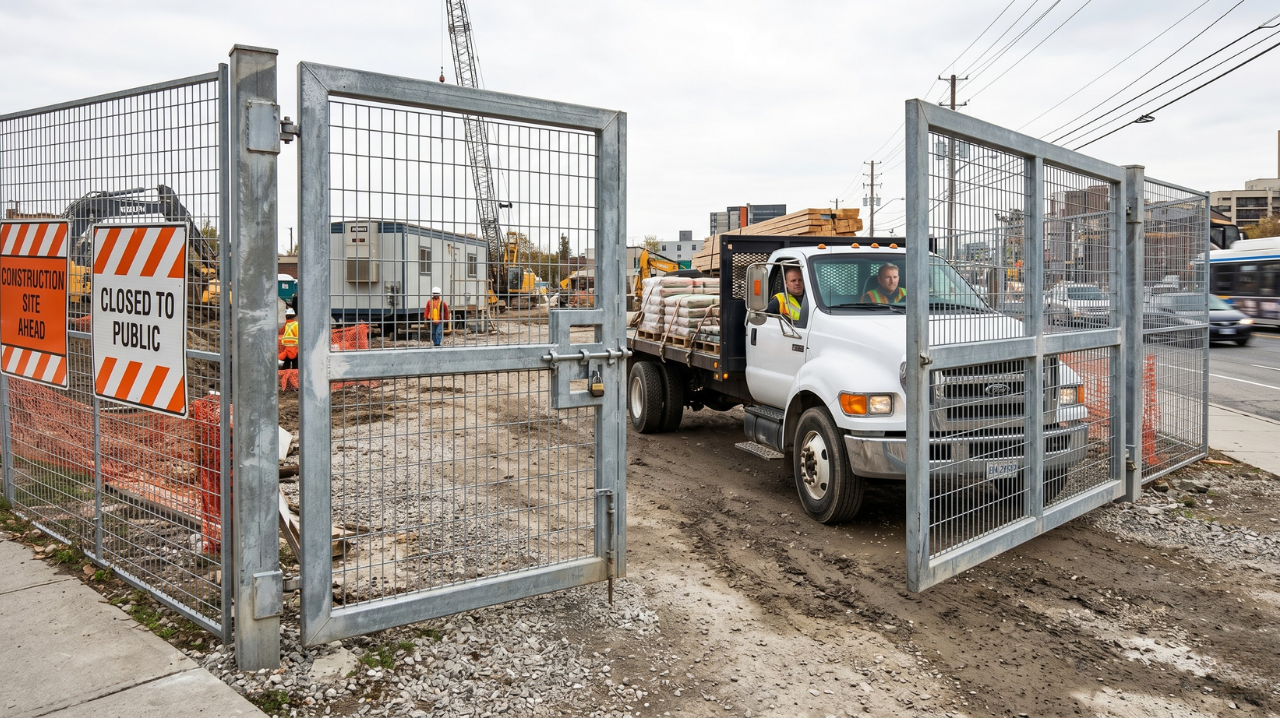
Size vehicle gates for the widest equipment or vehicle that will access the site during the full project lifecycle, not just the first delivery.
- Standard vehicle gate: 12 to 14 feet clear opening for pickup trucks, cargo vans, and standard flatbed deliveries.
- Heavy equipment gate: 16 to 20 feet clear opening for excavators, dump trucks, concrete mixers, and wide-load flatbeds. If heavy equipment will access the site at any point in the project, size the gate for that equipment from day one.
- Positioning: Gates should allow the longest entering vehicle to clear the opening without a multi-point turn that blocks the adjacent traffic lane or sidewalk. On urban sites, position at the widest available curb cut or away from intersections.
One consistent error in vehicle gate planning is sizing the opening for the equipment that arrives in the first week rather than for the full project. Re-installing a wider gate mid-project after the site is operational is avoidable with a single pre-mobilization decision.
Pedestrian Gate Requirements
- Clear opening width: 3 to 4 feet. The minimum pedestrian gate clear width in most North American jurisdictions is 32 to 36 inches for a single-person pass-through. Where two-way pedestrian traffic is expected, a minimum of 4 feet is appropriate.
- Emergency egress: Per OSHA 29 CFR 1926.34, pedestrian gates must never block required means of egress and must be openable from the inside without a key when the site is occupied.
- Separation from vehicle traffic: Pedestrian and vehicle gates should not share the same opening on any site with active equipment traffic. A separate designated pedestrian gate with clear signage reduces vehicle-pedestrian conflict at the entry point.
Swing vs Sliding Gate Selection
- Swing gates: Lower cost, simpler hardware, easier to inspect and maintain. Require a clear inward swing radius of 1.5 to 2 times the gate width. All construction site gates in North America must swing inward. A gate that opens outward over a public sidewalk is a direct code violation under most municipal ordinances.
- Sliding gates: Higher cost and more complex hardware, but no swing clearance required. Correct choice on constrained urban sites where the inward swing radius would place the open gate in the path of active equipment or pedestrian traffic.
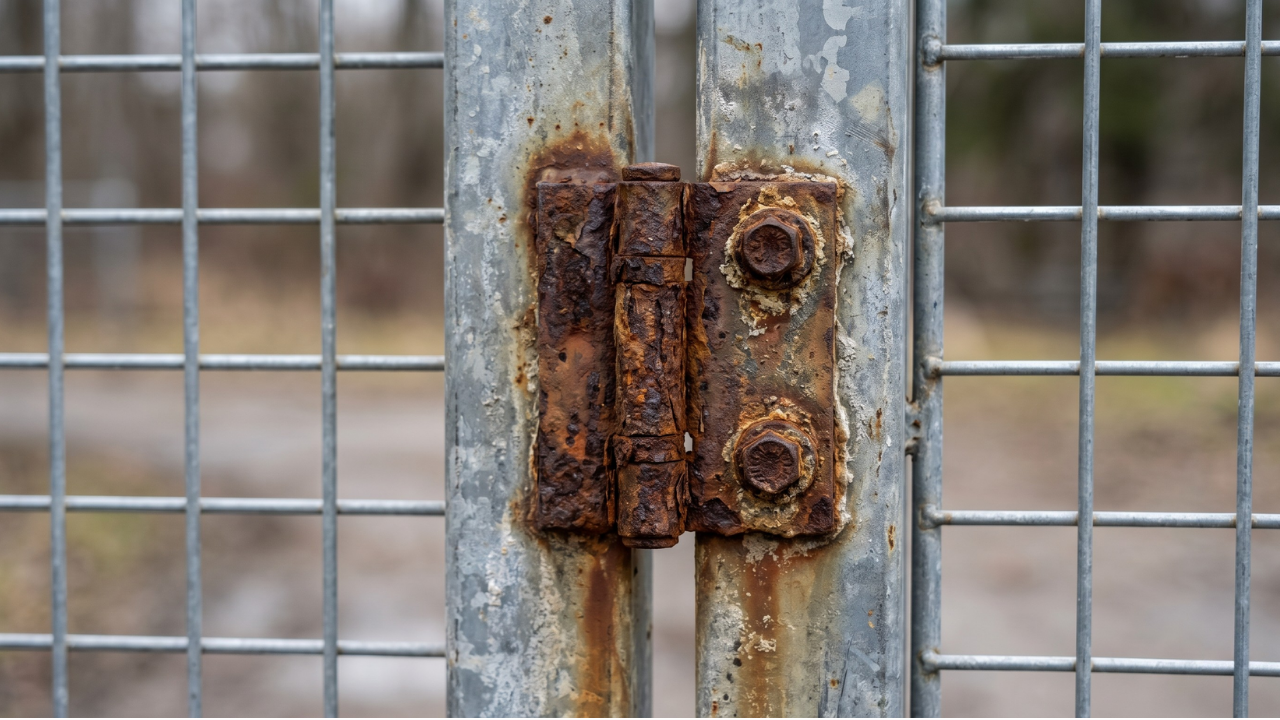
- Hardware inspection before spring startup: All hinges, latches, rollers, and locking hardware should be inspected before the site opens. Hardware corroded by road salt and de-icing spray over winter fails at the point of greatest need: the start of construction season, when traffic volume is at its peak.
Spring Inspection Readiness: What Inspectors Look for on Base and Gate Systems
Spring inspections focus on the components most likely to be degraded by winter conditions. On base and gate systems, the most common inspection findings include:
- Tube stands or Broadblock bases that have shifted or leaned due to frost heave, leaving panels below the required height
- Missing or inadequate Broadfoot ballast on screened fence runs. Inspectors push-test panels on screened runs specifically
- Windbreak stabilizers missing on screened or high-wind-exposure runs
- Gate hardware, hinges, latches, and locking mechanisms that are corroded, bent, or non-functional
- Gates swinging outward over public rights-of-way
- Vehicle gate openings narrowed by fence creep or base displacement over winter
- T-bar anchors that have heaved and are no longer at their original depth
- Anchor positions that have shifted, leaving the base foot unanchored
Complete the pre-season walkthrough before the site opens. Walk the full perimeter, push-test every panel, check every gate under load, confirm all anchor depths, and document the inspection with date and sign-off.
Practical Steps Before Spring Mobilization
- Confirm surface type and ground penetration status. Utility locates, pavement conditions, and subsurface restrictions determine whether T-bar anchoring is viable or whether the design requires a fully weighted Broadfence surface system.
- Select the correct Broadfence base for each fence run segment. Anticlimb Tube Stand for hard surfaces and commercial sites. Broadblock or Select Stand for lighter-duty or portable applications. Zero-Trip Stabilizer Base or Thermoplastic Hi-Viz Foot for pedestrian interfaces. Document the specification per run.
- Add Broadfoot ballast and windbreak stabilizers for spring conditions. Any run carrying screening, branding fabric, or windscreen, or on an exposed or elevated position, requires windbreak stabilizers in addition to the primary base and Broadfoot weights.
- Re-check all T-bar anchors installed before or during winter. Probe, pull-test, or re-drive any anchor that may have been affected by frost heave or soil instability. Re-drive to the full specified depth before placing the fence in service.
- Specify and position gates before the site opens. Confirm the vehicle gate clear width for the widest anticipated equipment load. Confirm pedestrian gate positioning relative to emergency egress requirements. Inspect all gate hardware under load before opening day.
- Document the completed inspection. Record the Broadfence base type and Broadfoot ballast specification for each run, confirm anchor status, and sign off on the gate hardware inspection. Keep the record in the site file as your first line of defense in any citation dispute.
Next Steps
Base type, anchoring depth, and gate placement are the three perimeter decisions that most directly affect how your temporary fencing performs in spring conditions—getting them right before mobilization costs far less than correcting them after inspectors are active on your site.
Broadfence supplies the complete base system lineup, including the Anticlimb Tube Stand, Broadfoot fence weights, Zero-Trip Stabilizer Base, Broadblock, Select Stand, Elite Feet, windbreak stabilizers, gates, and accessories across North America. Explore the full range at broadfence.com/temporary-fencing or contact the team to discuss base specifications and panel configurations for your spring project.
SOURCE LIST — APA 7 FORMAT:
Occupational Safety and Health Administration. (2024). 29 CFR 1926.502 — Fall protection systems criteria and practices. U.S. Department of Labor. https://www.osha.gov/laws,regs/regulations/standardnumber/1926/1926.502
Occupational Safety and Health Administration. (2024). 29 CFR 1926.651 — Specific excavation requirements. U.S. Department of Labor. https://www.osha.gov/laws,regs/regulations/standardnumber/1926/1926.651
Occupational Safety and Health Administration. (2024). 29 CFR 1926.34 — Means of egress. U.S. Department of Labor. https://www.osha.gov/laws,regs/regulations/standardnumber/1926/1926.34
Occupational Safety and Health Administration. (2024). 29 CFR 1926.200 — Accident prevention signs and tags. U.S. Department of Labor. https://www.osha.gov/laws,regs/regulations/standardnumber/1926/1926.200
Government of Ontario. (2024). Ontario Regulation 213/91 — Construction projects, s. 65. https://www.ontario.ca/laws/regulation/910213
Call811.com. (2026). Know what is below. Call before you dig. https://call811.com
Construction Safety Association of Ontario. (2014). Perimeter fencing [PDF]. https://www.constructionsafety.ca/wp-content/uploads/2014/08/Perimeter-Fencing.pdf
Moduloc. (2023). Screening on fence: A risky business. https://moduloc.ca/blog/screening-on-fence-a-risky-business/
AR Fence. (2026). OSHA temp fencing requirements 2026: Contractor guide. https://arfence.com/osha-temporary-fencing-requirements/
Safety Evolution. (2025). Top 10 OSHA violations in 2025 (with fixes for contractors). https://www.safetyevolution.com/blog/top-10-osha-violations-in-2025
Clarksville Fencing. (2024). Spring fence inspection checklist: What winter may have damaged. https://clarksvillefencing.com/spring-fence-inspection-checklist/
NYC Department of Buildings. (2024). Project categories: Construction equipment — Construction fence. https://www.nyc.gov/site/buildings/dob/project-categories-cons-fence.page